Jordan Fischer · 3 October 2026
Material Degradation Pathways in Environments with Frequent Thermal Cycling Events
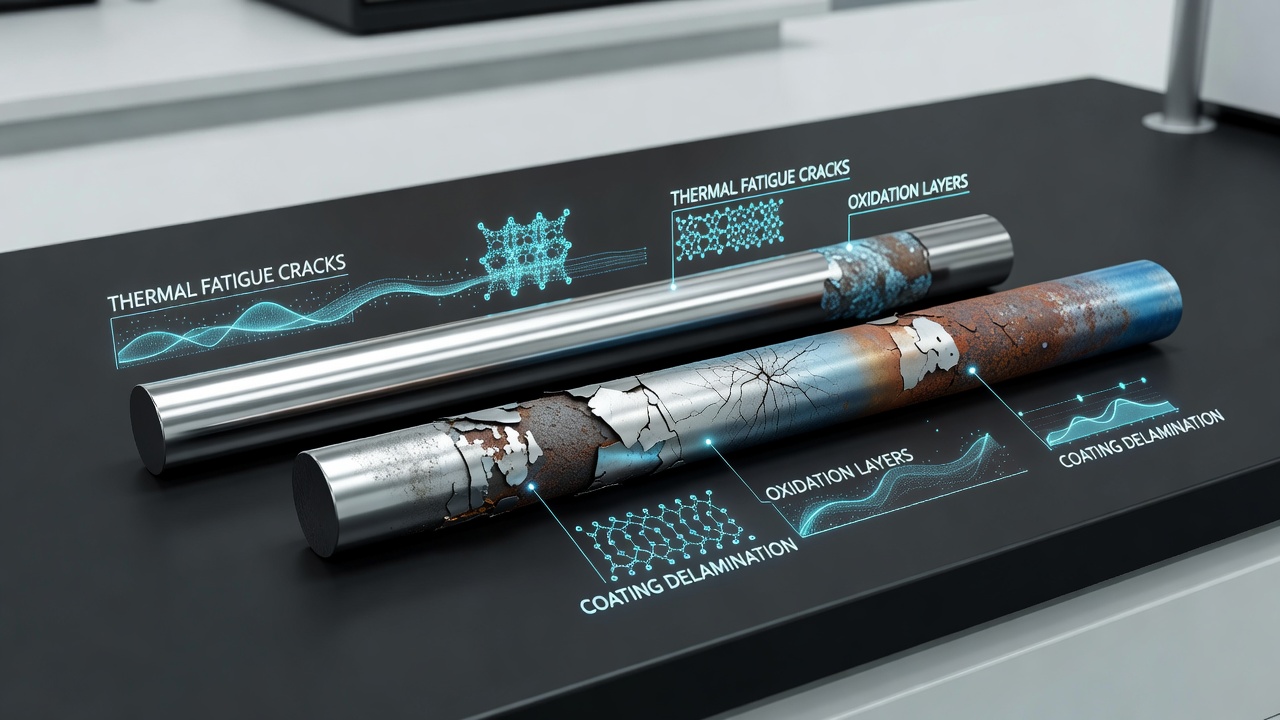
Thermal cycling subjects materials to repeated temperature swings that drive expansion and contraction cycles, and these mechanical stresses accumulate over time to initiate several distinct degradation pathways. Engineers track these processes closely in aerospace components, power plant turbines, and electronic assemblies where daily or seasonal temperature fluctuations remain the norm. Research indicates that the frequency and amplitude of each cycle determine how quickly internal damage progresses from microscopic flaws to visible structural compromise.
Core Mechanisms Behind Degradation
Repeated heating forces atoms within a lattice to vibrate more vigorously while cooling pulls them back into tighter arrangements, and the resulting strain often exceeds the material's elastic limit after hundreds or thousands of iterations. Fatigue cracking emerges first along grain boundaries in metals, whereas polymers experience chain scission and cross-link breakdown that reduce flexibility. Ceramics develop surface spalling when mismatched thermal expansion coefficients between layers create shear forces at interfaces. Observers note that oxidation accelerates once cracks open fresh surfaces to air or process gases, turning a mechanical issue into a combined chemical and mechanical attack.
Material-Specific Responses Across Industries
Nickel-based superalloys used in turbine blades show pronounced creep-fatigue interaction when exposed to 900-degree swings multiple times per hour, while aluminum alloys in automotive exhaust systems develop intergranular corrosion after far fewer cycles. Composite laminates in satellite structures suffer delamination because resin matrices shrink at different rates than reinforcing fibers, and data from accelerated testing programs confirm that moisture trapped at interfaces expands during heating phases to widen those separations further. Electronics packaging encounters solder joint fatigue as coefficient mismatches between silicon dies and organic substrates concentrate strain at connection points.
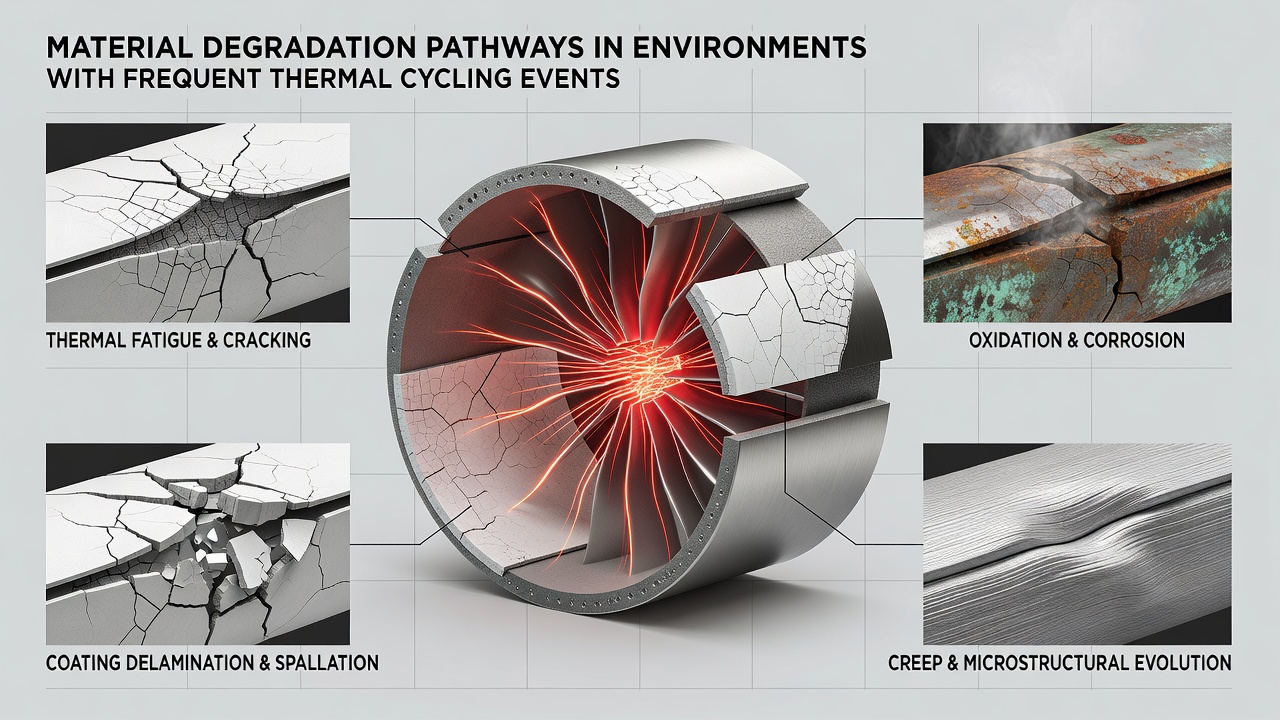
Studies conducted at facilities across North America and Europe reveal that coatings intended to protect base materials can themselves become the weakest link when their own expansion behavior diverges from the substrate. In October 2026 researchers presenting at an international materials symposium shared updated models that predict coating spallation rates more accurately by incorporating real-time sensor data from operating equipment. Those models now help operators adjust duty cycles before cumulative damage reaches critical thresholds.
Environmental Factors That Modify Pathways
Atmospheric composition, humidity levels, and the presence of contaminants alter which degradation route dominates, and salt-laden coastal air speeds up pitting once cracks initiate. High-pressure hydrogen environments promote embrittlement in steels while vacuum conditions in space remove oxide layers that might otherwise slow crack growth. Researchers at Canadian and Australian laboratories have documented how ultraviolet exposure combined with thermal cycling degrades polymer matrix composites faster than either stressor alone would suggest.
Monitoring and Mitigation Approaches
Non-destructive evaluation techniques such as ultrasonic phased-array scanning and infrared thermography allow detection of subsurface cracks before they reach the surface, and operators integrate these inspections into scheduled maintenance windows. Design strategies include selecting materials with closely matched thermal expansion coefficients, incorporating compliant interlayers, and applying diffusion barriers that limit oxygen ingress. Finite-element simulations now incorporate temperature-dependent material properties to forecast remaining life with greater precision, and field data from instrumented components continue to refine those predictions. NASA thermal fatigue reports provide extensive datasets that validate many of these modeling approaches across multiple alloy systems.
Conclusion
Material degradation under frequent thermal cycling follows predictable pathways once the dominant mechanisms for a given material and environment are identified, and ongoing measurement programs supply the data needed to extend service life. Continued refinement of predictive tools and inspection methods supports safer operation across critical infrastructure sectors. European Space Agency test summaries illustrate how similar principles apply in extreme vacuum conditions.