Jordan Fischer · 17 October 2026
Sensor Fusion Approaches for Stabilizing Performance Metrics Across Variable Load Scenarios in Advanced Thermal Regulation Frameworks
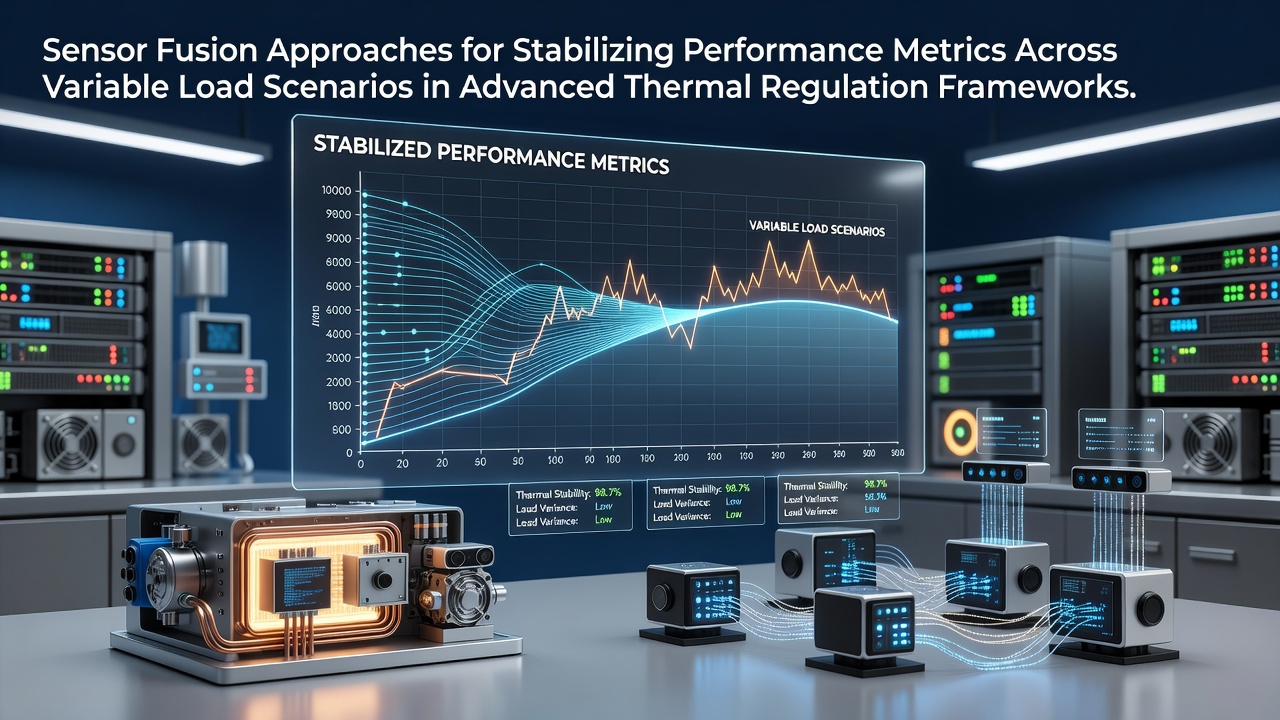
Sensor fusion techniques combine inputs from multiple sensors to produce more accurate and reliable performance estimates than any single sensor could provide on its own, and this integration proves especially valuable in advanced thermal regulation frameworks that must handle fluctuating computational or industrial loads. Engineers deploy these methods to keep metrics such as temperature variance, power consumption, and response latency within defined bounds even as external demands shift without warning. Data from temperature probes, current monitors, pressure transducers, and flow meters feed into fusion algorithms that reconcile conflicting readings and filter out noise introduced by rapid load changes.Core Sensor Fusion Methods in Thermal Systems
Kalman filtering remains a foundational approach because it recursively estimates the state of a dynamic system from noisy measurements, and researchers apply extended or unscented variants when nonlinear thermal behaviors appear under heavy loads. Particle filters offer an alternative when probability distributions become multimodal, which occurs frequently during sudden spikes in processing demand. In October 2026 several industrial testbeds plan to publish comparative results from side-by-side deployments of these filters across rack-scale cooling setups, allowing direct assessment of computational overhead versus stability gains.
Bayesian networks provide another route by encoding conditional dependencies among variables such as heat generation rate, coolant flow, and ambient conditions, while machine-learning models trained on historical load profiles increasingly supplement traditional statistical methods. Observers note that hybrid architectures, which switch between model-based and data-driven fusion depending on detected load regime, deliver lower error rates during both steady-state and transient phases.
Performance Stabilization Under Variable Loads
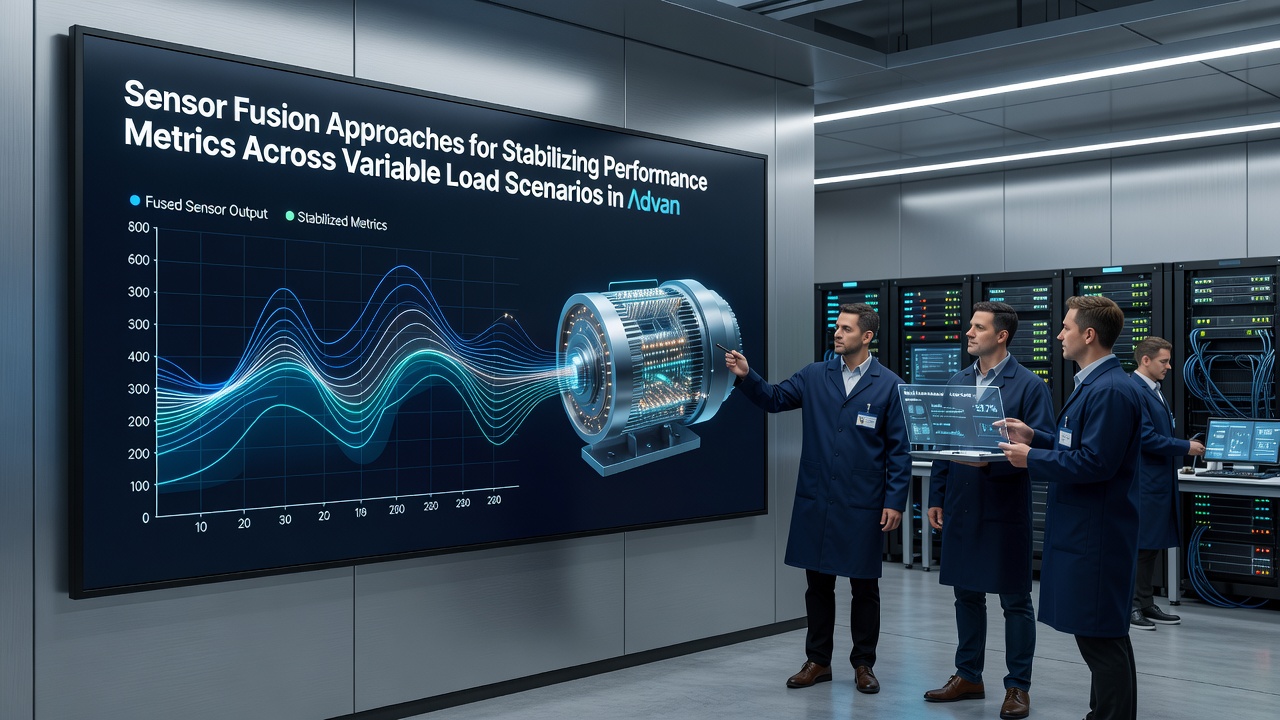
Variable load scenarios arise in data centers when virtual machines migrate, in manufacturing cells when production schedules change, and in electric vehicle powertrains when driving conditions evolve. Sensor fusion counters these variations by continuously updating an internal model of thermal mass and heat transfer coefficients, then issuing control signals to pumps, fans, or thermoelectric elements before temperature excursions exceed thresholds. Studies conducted at European research facilities demonstrate that fused sensor data reduces peak temperature overshoot by measurable margins compared with single-sensor feedback loops.
Implementation Considerations and Data Sources
Hardware constraints dictate the choice of fusion algorithm because embedded controllers often lack the floating-point capacity required for full particle-filter iterations. Engineers therefore prune state vectors or adopt lightweight sigma-point methods that preserve accuracy while fitting within memory budgets. Calibration routines run periodically to compensate for sensor drift, and these routines themselves benefit from cross-validation across redundant channels. According to guidelines published by the National Institute of Standards and Technology, consistent metadata tagging of raw sensor streams simplifies later fusion and audit tasks.
Geographically distributed test sites contribute additional insight. Canadian research groups have examined fusion performance in sub-zero ambient environments where thermal time constants lengthen, whereas Australian university laboratories focus on high-ambient desert conditions that compress those same time constants. Both sets of findings feed into open datasets that system designers consult when scaling frameworks for new climates or workload classes.
Integration with Broader Control Architectures
Thermal regulation frameworks rarely operate in isolation, and sensor fusion outputs commonly serve as inputs to higher-level optimizers that balance energy cost against service-level objectives. Middleware layers expose fused estimates through standardized interfaces, enabling supervisory controllers to adjust workload placement or initiate pre-cooling sequences. When load forecasts become available from scheduling systems, the fusion engine incorporates them as additional measurements with associated uncertainty values, tightening the overall prediction horizon.
Redundancy management forms another critical layer because individual sensors can fail or report outliers during electromagnetic interference events common in industrial settings. Fusion algorithms assign dynamic weights that down-rank suspect channels, and this weighting occurs without interrupting the main control loop. Documentation from the IEEE Sensors Council outlines recommended practices for quantifying the resulting uncertainty propagation through the fused output.
Conclusion
Sensor fusion approaches continue to evolve as computational resources improve and new sensing modalities emerge, yet the fundamental requirement remains consistent delivery of stable performance metrics despite load variability. Organizations evaluating these techniques examine trade-offs among accuracy, latency, and hardware cost using data from multiple geographic and climatic sources. Continued publication of benchmark results, including those scheduled around October 2026, supplies practitioners with the quantitative basis needed to select and tune fusion methods for their specific thermal regulation frameworks.